
Julian Mooney is Director of Agronomy, at Turfgrass®, a global agronomy consultancy and golf course project management company. Contact Julian at: julian@turfgrass.golf
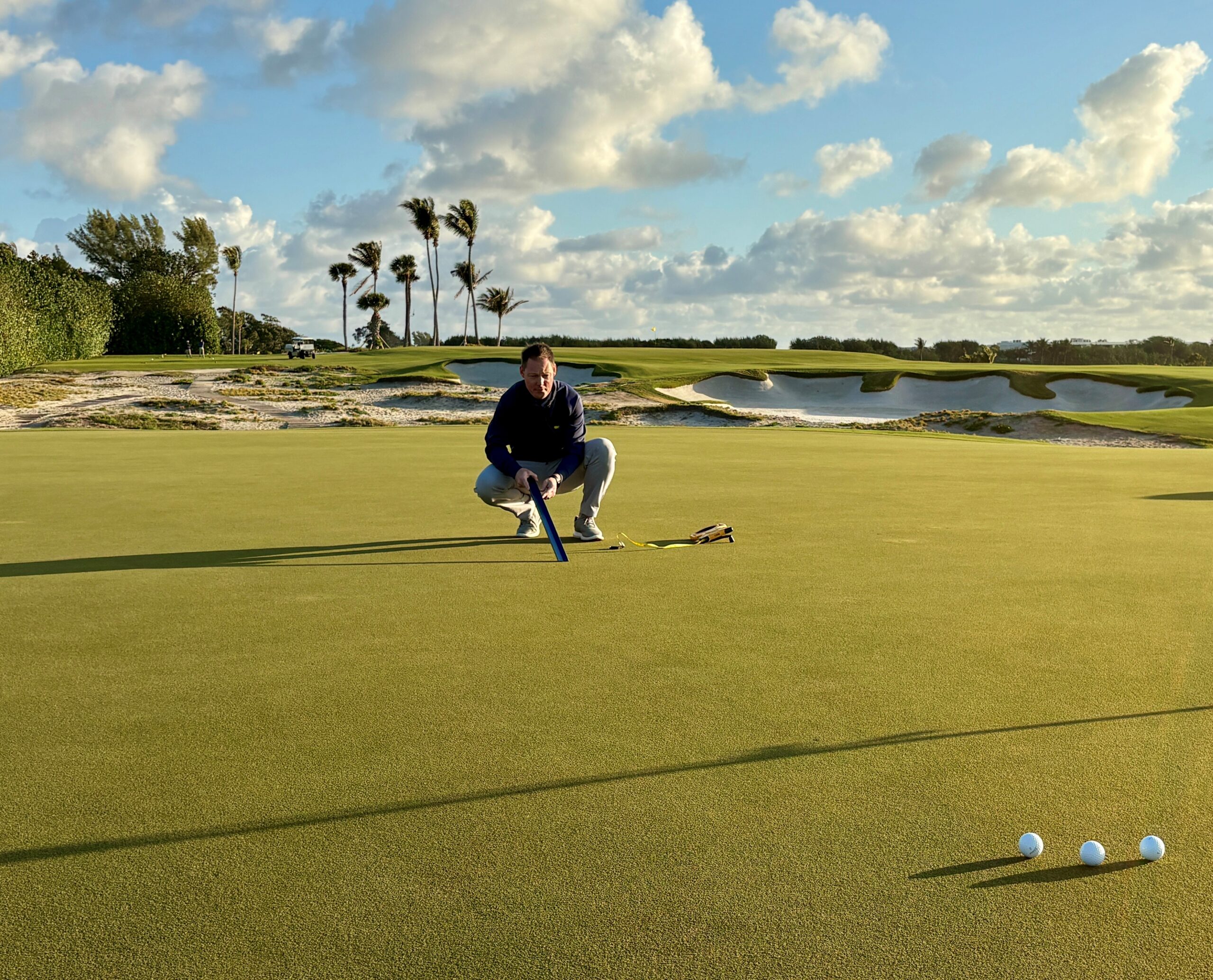
Adam Moeller, Turfgrass® Director of Agronomy for North America, recording green speed during a Pro-Member competition.
Producing the desired green speed and firmness for a significant competition, whether a club medal or an international televised event, can place a lot of pressure on the Superintendent and their team. The best set ups are nearly always the result of good golf agronomy and thoughtful preparation, not a last minute push for a headline number. Our role at Turfgrass® is a supporting one, helping clubs think through options, understanding trade offs, and drawing a line between fairness, playability, and ultimately turf health.
This article is offered as a working document to support that planning process. It is not a universal template, and it should not be read as “the only way” to do things. Instead, it summarises a set of considerations, speed, firmness, smoothness, trueness, moisture, surface contour, that can help a club choose an appropriate performance range for its greens, whether the goal is a successful club competition or consistent conditions across an internationally televised event.
When the discussion begins, it often narrows quickly to a single number, “The greens are 11 (on the stimpmeter) today,” or “They were quicker yesterday.” In reality, what golfers experience is a blend of speed (ball roll distance), firmness, smoothness, trueness and surface contour. Firmness is how the surface reacts when a ball lands, and it is closely linked to organic matter and moisture. Smoothness and trueness describe the lateral and vertical deviation of a ball from its intended line. Finally contour of the green is an element which ultimately determines green speed and one which needs to be respected to avoid putting surfaces becoming unplayable.
All these variables are important, but when a player is about to putt the two most important factors in that moment are trueness and speed, that is why we focus less on chasing a speed/headline number and more on producing a predictable roll, where the player can anticipate and trust how a ball will roll on a putting surface.
A key challenge is that some influences are outside anyone’s control. Air and soil temperature, sunshine, wind and humidity all shift speed and firmness from day to day and even hour to hour. A cool, overcast day can play half to a full foot slower than the day before, even with the same maintenance programme. On a bright, breezy afternoon, surfaces can dry and firm naturally, and the drop off in speed can be negligible.
What we can influence are the day to day operational adjustments. Mowing height and frequency are key drivers. Lower heights and more frequent mowing generally increase speed, but with added stress, particularly on Poa annua dominant greens and/or in hot, dry periods. Rolling is another useful tool when implemented diligently, improving smoothness and adding speed without automatically increasing risk. Surface moisture is often a key influencing factor. As the surface dries and firms, the ball rolls further, but too low a soil moisture content will result in wilt stress. Organic matter is another key influencer. As organic matter increases, macro pores decrease resulting in decreased infiltration and higher capillary porosity and moisture retention, all of which increase the likelihood of softer greens and inconsistency. Hence the importance of preventing organic matter buildup via an optimized turf growth rate, sand topdressing and aeration.
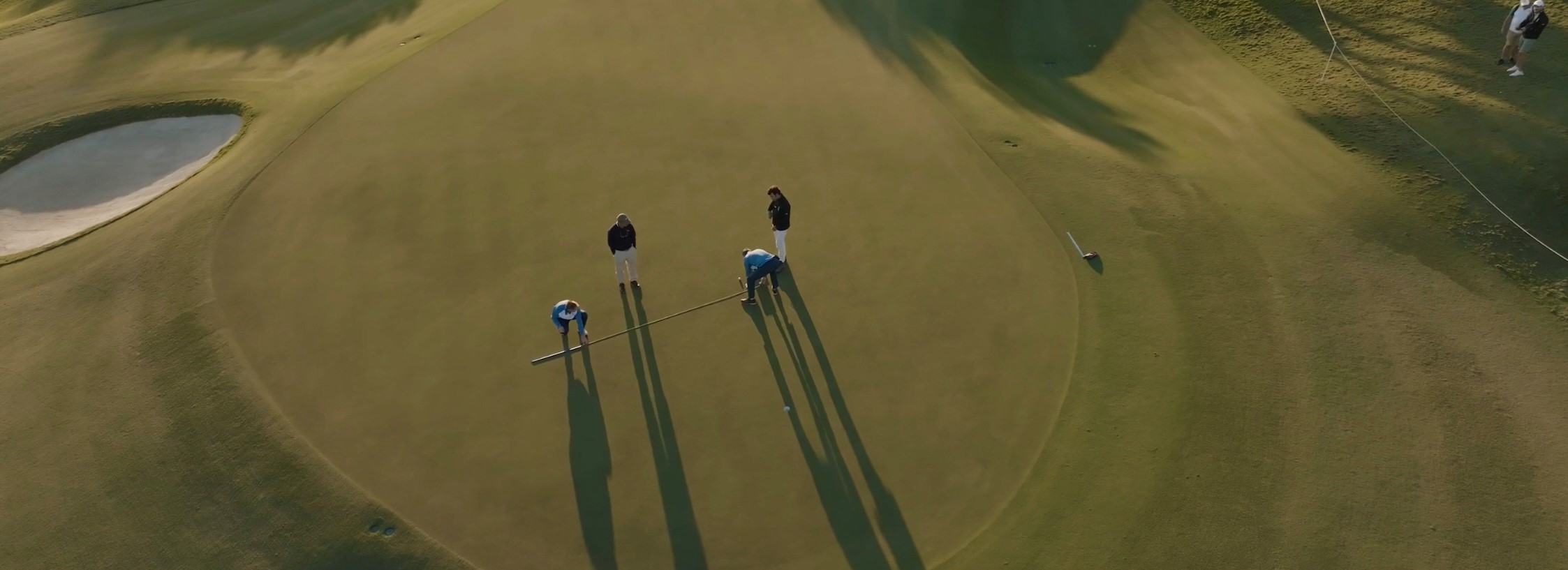
Turfgrass® staff members Julian Mooney and Adam Moeller recording green speed during morning setup for the 2023 Solheim Cup at Finca Cortesin.
Tournament weeks typically elevate the decision making around speed and firmness. For bigger events, the conversation is usually about achieving a desired performance ranges, rather than simply pushing for maximum speed and firmness. We want speeds and firmness that provide challenge, while keeping intended hole locations fair, especially on greens with stronger contour. The best playing surfaces are created months in advance by the agronomy team through steady organic matter management and consistent distribution uniformity of moisture. In the final stages, the focus becomes fine tuning – measuring performance, monitoring moisture and growth, and making small adjustments through mowing, rolling and careful water management. On heavily contoured greens, even modest changes in speed can have big consequences, which is why set up planning needs to include hole location practicality and the ability for balls to remain at rest.
Even with extra labour and close monitoring, greens will not be identical from one day to the next. The goal is for predictable playing surfaces within a pre-determined range. This is also where the law of diminishing returns becomes important. Pushing green speed can improve playability but pushing greens outside of a sensible upper end target often makes interesting/challenging hole locations unusable and raises agronomic risk, particularly in hot, dry or windy weather. It’s a point made well in Dr Tom Nikolai’s work on putting green speed – the right speed is not universal; it depends on contour, turf type, climate and the golfers who play the course.
For daily play, we recommend a simple framework rather than a chase for a magic number. Start by understanding your greens, the construction type, dominant species, contour severity, and any known weak points such as shade or drainage. That quickly shows what is realistic and which greens will dictate your “speed limits”. Next, set ranges rather than fixed targets. Seasonal bands, slightly slower in winter, a peak season range, and a higher band reserved for key events where contour allows, are more practical, more sustainable, and easier to deliver consistently compared to a fixed range. Then monitor speed, firmness, moisture and ball performance so decisions don’t rely on memory or complaints. You don’t need a cart full of technology, a stimpmeter, a firmness meter, a moisture meter and clipping volume all logged in a database will tell a clear story. Finally, agree boundaries with your committee, such as limits on consecutive days of aggressive practices, minimum moisture thresholds during stress periods, and practical maximums for steep or sensitive greens.
Communication is often where all this succeeds or fails. When golfers say “the greens were slow,” they may be reacting to overnight softness, a tougher hole location, or natural afternoon growth and traffic. Rather than debating inches, it helps to talk in terms of consistency, fairness and sustainability. Our aim is that the ball behaves predictably across all 20 greens and that hole locations remain playable. The number will move naturally with weather. We can elevate performance for special occasions, but holding tournament week intensity all season is unsustainable in most climates and grass types.
After big events we are often asked, “Can we have the greens like that all the time?” Clubs can absolutely borrow the process, clear target ranges, measurement, and disciplined decision making, and bring elements of that performance into daily golf. What they shouldn’t chase is a headline number at the expense of fairness and turf health. If the foundations are right, you don’t need record speeds to deliver a world class experience. You need greens that are firm enough to reward good strikes, smooth and true enough that putts behave as read, and fast enough to be engaging without becoming one dimensional. We want golfers to walk off the 18th saying “those greens were great” without obsessing over a green speed and that’s usually the best sign we have got it right.

About the Author
Julian Mooney
Director of Agronomy
Julian Mooney is Director of Agronomy at Turfgrass®. He has worked on site at multiple professional events in a tournament agronomy role, supporting the rules team at the Solheim Cup and at events hosted by LIV Golf and the Ladies European Tour.